.jpg)
World’s Top 10 Largest Wheel Loaders
(2026 Update)
By Patrik Eder · Published: June 30, 2026
In 2026, the global mining and heavy construction sectors are being redefined by a new generation of heavy-duty loaders designed for maximum throughput and decarbonized efficiency. As the global demand for raw materials reaches record highs, the largest wheel loaders in the world have evolved into sophisticated, "software-defined" titans capable of moving mountains with surgical precision.
These mining loaders are no longer just about brute force; they represent a massive technological leap, integrating hybrid-electric powertrains and advanced kinematics to optimize cost-per-ton ratios in the harshest environments on Earth. From high-altitude copper mines to massive open-pit operations, industry leaders like Caterpillar, Komatsu, and XCMG are pushing the boundaries of what modern construction equipment can achieve.
Ranking based on maximum operating weight:
1. Komatsu WE2350-2 - 272,065 kg (599,801 lbs)
2. Komatsu WE1850-3 - 269,887 kg (594,999 lbs)
3. Caterpillar 995 - 248,421 kg (547,675 lbs)
4. Komatsu WA1200-6 - 218,300 kg (481,269 lbs)
5. Komatsu WE1350-3 - 196,496 kg (433,200 lbs)
6. XCMG XC9350 - 150,000 kg (330,693 lbs)
7. Caterpillar 993K - 133,668 kg (294,687 lbs)
8. Komatsu WA900-8 - 116,720 kg (257,324 lbs)
9. Komatsu WA800-8 - 115,530 kg (254,700 lbs)
10. BelAZ 78250 - 107,800 kg (237,658 lbs)
Methodology for Ranking the Largest Wheel Loaders in the World
Our 2026 ranking of the world’s largest wheel loaders is based on a rigorous analysis of OEM specifications and field data, prioritizing maximum operating weight as the primary metric. In the ultra-class category, operating weight is the most definitive indicator of structural capability and tipping stability, providing the necessary ballast to safely maneuver payloads exceeding 70 tons. Leading machines in this report boast operating weights surpassing 250 metric tons.
Beyond physical scale, we evaluate secondary benchmarks including rated payload, volumetric bucket capacity - now frequently exceeding 40 cubic meters - and breakout force, which is essential for hard-rock excavation. We also analyze engine horsepower to assess overall powertrain efficiency. Finally, our methodology considers a machine’s utility within modern mining ecosystems, specifically focusing on pass-matching compatibility with ultra-class haul trucks, the adoption of hybrid-electric drives for reduced emissions, and the integration of autonomous software-defined controls that optimize cycle times and improve overall jobsite safety.
10. BelAZ 78250

Image source: BelAZ
Ranked 10th in the list, the BelAZ 78250 is a wheel loader manufactured in Belarus. With an operating weight of 107,800 kg (107.8 metric tons), it is the largest wheel loader produced in the Commonwealth of Independent States (CIS). The machine is designed for mining operations in Eurasian and Siberian regions, including use in unstable terrain and hazardous post-blast zones.
The 78250 is powered by a Cummins QST30-C engine producing 783 kW (1,050 HP). It utilizes an AC electromechanical transmission instead of a traditional mechanical drivetrain, providing stepless acceleration and torque distribution to the wheels. This system works in conjunction with an electrodynamic braking network that allows the machine to decelerate without primary reliance on friction-based mechanical brakes.
The technical specifications of the BelAZ 78250 include a bucket capacity of 11.3 m³ and a rated payload of 22,000 kg. The machine's physical dimensions are 15.35 metres in length, 5.14 metres in width, and 5.60 metres in height, with an outside turning radius of 11 metres. It is designed to be paired with dump trucks with payloads ranging from 90 to 130 tonnes.
The machine’s electronics and telematics support full remote-control operation from a distance of up to 1.5 kilometres. With its verified operating weight, the BelAZ 78250 maintains the tenth position in the 2026 rankings, placing above the Caterpillar 992.
| Specification | Details |
| Manufacturer | BelAZ |
| Model | 78250 |
| Operating Weight | 107,800 kg (237,658 lbs) |
| Engine Power | 783 kW (1,050 HP) |
| Bucket Capacity | 11.3 m³ (14.8 yd³) |
| Rated Payload | 22,000 kg (48,500 lbs) |
| Breakout Force | N/A |
| Drive Type | Electromechanical AC |
9. Komatsu WA800-8

Image source: Komatsu
Ranked 9th in the list, the Komatsu WA800-8 has an operating weight of 115,530 kg (115.5 metric tons). It shares a chassis architecture and a 12-cylinder SAA12V140E-7 engine block with the WA900-8, with the engine output set at 637 kW (854 HP). The machine is designed for continuous re-handling applications in abrasive environments such as coal mines and aggregate quarries.
The WA800-8 features a mechanical power shift drive and a reinforced loader linkage with increased arm plate width to address torsional stress. Its technical specifications include a bucket capacity of 11.5 m³, a rated payload of approximately 21 metric tons, and a breakout force of 690 kN. The machine measures 4.93 metres in width over the tyres. The loader is equipped with wet, multi-disk service brakes and an integrated high-capacity cooling system.
To facilitate operation in cold climates, an automated engine pre-lubrication system circulates oil prior to ignition. Additional components include a dual-element air cleaner with a dust indicator and a swing-out reversible hydraulic cooling fan to manage airborne particulate matter.
The WA800-8 features a mechanical power shift drive and a reinforced loader linkage with increased arm plate width to address torsional stress. Its technical specifications include a bucket capacity of 11.5 m³, a rated payload of approximately 21 metric tons, and a breakout force of 690 kN. The machine measures 4.93 metres in width over the tyres. The loader is equipped with wet, multi-disk service brakes and an integrated high-capacity cooling system.
To facilitate operation in cold climates, an automated engine pre-lubrication system circulates oil prior to ignition. Additional components include a dual-element air cleaner with a dust indicator and a swing-out reversible hydraulic cooling fan to manage airborne particulate matter.
| Specification | Details |
| Manufacturer | Komatsu |
| Model | WA800-8 |
| Operating Weight | 115,530 kg (254,700 lbs) |
| Engine Power | 637 kW Net (854 HP) |
| Bucket Capacity | 11.5 m³ (15.0 yd³) |
| Rated Payload | ~ 21 metric tons (~ 46,000 lbs) |
| Breakout Force | 690 kN (155,117 lbs) |
| Drive Type | Mechanical (Power Shift) |
8. Komatsu WA900-8

Image source: Komatsu
Ranked 8th in the list, the Komatsu WA900-8 is a wheel loader with an operating weight of 116,720 kg in its high-lift configuration and 116,400 kg in the standard version. It is designed for operation in quarry environments and medium-scale open-pit mines, where it is intended to load trucks with payloads between 70 and 150 tonnes, such as the Komatsu HD785.
The machine is powered by a Komatsu SAA12V140E-7 Tier 4 Final engine that produces 671 kW (899 HP). It utilizes a mechanical power shift drive and a Z-bar linkage design. The technical specifications include a bucket capacity ranging from 11.5 to 14.5 m³, a rated payload of approximately 25 metric tons, and a breakout force of 755 kN. The loader measures 4.58 metres in width over the tyres and has a total length exceeding 14 metres.
The WA900-8 incorporates SmartLoader Logic software paired with a closed-center load-sensing hydraulic system to match engine torque to hydraulic demand. For operator situational awareness, the machine is equipped with the KomVision system, which uses a network of high-definition cameras and radar sensors to provide a 270-degree bird's-eye view of the surrounding area.
The machine is powered by a Komatsu SAA12V140E-7 Tier 4 Final engine that produces 671 kW (899 HP). It utilizes a mechanical power shift drive and a Z-bar linkage design. The technical specifications include a bucket capacity ranging from 11.5 to 14.5 m³, a rated payload of approximately 25 metric tons, and a breakout force of 755 kN. The loader measures 4.58 metres in width over the tyres and has a total length exceeding 14 metres.
The WA900-8 incorporates SmartLoader Logic software paired with a closed-center load-sensing hydraulic system to match engine torque to hydraulic demand. For operator situational awareness, the machine is equipped with the KomVision system, which uses a network of high-definition cameras and radar sensors to provide a 270-degree bird's-eye view of the surrounding area.
| Specification | Details |
| Manufacturer | Komatsu |
| Model | WA900-8 |
| Operating Weight | 116,720 kg (High Lift) / 116,400 kg (Standard) |
| Engine Power | 671 kW Net (899 HP) |
| Bucket Capacity | 11.5 – 14.5 m³ (15.0 – 19.0 yd³) |
| Rated Payload | ~ 25 metric tons (~ 55,000 lbs) |
| Breakout Force | 755 kN (169,754 lbs) |
| Drive Type | Mechanical (Power Shift) |
7. Caterpillar 993K
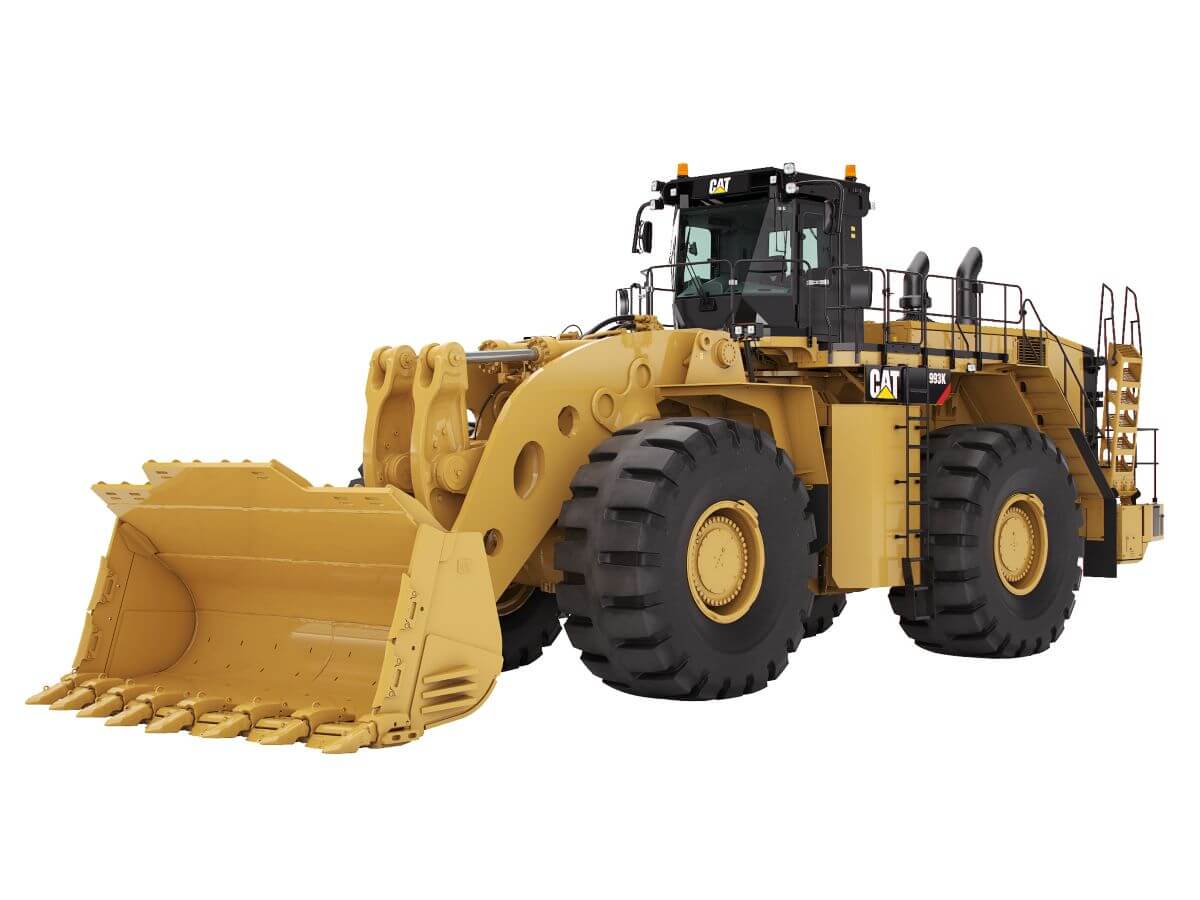
Image source: Caterpillar
Ranked 7th in the list, the Caterpillar 993K has an operating weight of 133,668 kg (133.6 metric tons). It is utilised as a primary loader for 100-ton trucks, such as the Cat 777, or as a secondary loader for truck fleets between 150 and 200 tons. The machine is powered by a Cat C32 ACERT engine with twin turbochargers and an air-to-air aftercooler, providing 726 kW (973 HP) of net power and a 33% torque rise.
Technical specifications include a bucket capacity ranging from 12.2 to 23.7 m³, a standard rated payload of 27.2 metric tons, and a breakout force of 718 kN. The loader's dimensions are 15.57 metres in length and 5.08 metres in width. It employs a mechanical power shift drive and a Positive Flow Control (PFC) hydraulic system that synchronises pump output with operator lever movement to manage system heat and cycle speeds.
The 993K features a Powertrain Torque Strategy (PTS) system to electronically modulate engine speed and torque converter output, which is intended to reduce tyre spin. It also incorporates integrated electronics, including the Cat Production Measurement (CPM) system and a Cycle Timer, which monitor the loading sequence across eight distinct phases to provide data on loading efficiency and payload distribution.
| Specification | Details |
| Manufacturer | Caterpillar |
| Model | 993K |
| Operating Weight | 133,668 kg (294,687 lbs) |
| Engine Power | 726 kW Net (973 HP) |
| Bucket Capacity | 12.2 – 23.7 m³ (16.0 – 31.0 yd³) |
| Rated Payload | 27.2 metric tons (30.0 tons) |
| Breakout Force | 718 kN (159,562 lbs) |
| Drive Type | Mechanical (Power Shift) |
6. XCMG XC9350

Image source: XCMG
Ranked 6th in the list, the XCMG XC9350 is a wheel loader produced in China with a component localisation rate of over 80%. It has an operating weight ranging from 150,000 kg to a maximum of 170,000 kg. The machine is engineered to support mining trucks with payloads of 130 to 200 tonnes in open-pit coal, iron, and copper operations.
The powertrain consists of a 970 kW (1,300 HP) diesel engine driving a high-capacity generator as part of an AC-DC-AC electric drive system. This architecture delivers power to individual AC squirrel-cage motors in each wheel hub, removing the need for mechanical axles and enabling independent torque vectoring.
Technical specifications include a bucket capacity of 18.0 m³, a rated payload of 35,000 kg, and a maximum breakout force of 961 kN. The loader has a total cycle time of 21 seconds and a dumping clearance of 6,197 mm. Its physical dimensions are 17.25 metres in length, 5.69 metres in width, and 6.52 metres in height.
The XC9350 incorporates an electro-hydraulic braking (EHB) energy recovery system. This hybrid capability captures kinetic energy during deceleration to assist the wheel-end reducers, leading to an estimated 20% reduction in fuel consumption compared to hydrodynamic systems and minimal mechanical brake pad wear.
The powertrain consists of a 970 kW (1,300 HP) diesel engine driving a high-capacity generator as part of an AC-DC-AC electric drive system. This architecture delivers power to individual AC squirrel-cage motors in each wheel hub, removing the need for mechanical axles and enabling independent torque vectoring.
Technical specifications include a bucket capacity of 18.0 m³, a rated payload of 35,000 kg, and a maximum breakout force of 961 kN. The loader has a total cycle time of 21 seconds and a dumping clearance of 6,197 mm. Its physical dimensions are 17.25 metres in length, 5.69 metres in width, and 6.52 metres in height.
The XC9350 incorporates an electro-hydraulic braking (EHB) energy recovery system. This hybrid capability captures kinetic energy during deceleration to assist the wheel-end reducers, leading to an estimated 20% reduction in fuel consumption compared to hydrodynamic systems and minimal mechanical brake pad wear.
| Specification | Details |
| Manufacturer | XCMG |
| Model | XC9350 |
| Operating Weight | 150,000 kg – 170,000 kg (Max) |
| Engine Power | 970 kW (1,300 HP) |
| Bucket Capacity | 18.0 m³ (23.5 yd³) |
| Rated Payload | 35,000 kg (77,161 lbs) |
| Breakout Force | 961 kN (216,041 lbs) |
| Drive Type | AC-DC-AC Electric Drive / Hybrid |
5. Komatsu WE1350-3

Image source: Komatsu
Ranked 5th in the list, the Komatsu WE1350-3 is a wheel loader with an operating weight of 196,496 kg in its high-lift configuration and 194,228 kg in the standard version. It is designed to load haul trucks with capacities ranging from 181 to 236 tonnes. The machine is powered by a 1,249 kW (1,676 HP) engine and utilises a diesel-electric SR Hybrid Drive system paired with a Kinetic Energy Storage System (KESS).
The technical specifications for the WE1350-3 include a bucket capacity of 21.41 to 22.94 m³, a rated payload of 40,823 kg, and a breakout force of 1,004 kN. The machine has an estimated turning radius of 16.5 metres. The SR Hybrid Drive architecture results in up to 45% less diesel consumption compared to mechanical-drive equivalents in the same weight class.
The loader features a hydraulic cycle time of 30.1 seconds and is capable of moving up to 3,368 tonnes of material per hour. The drive system differs from traditional mechanical drivetrains by excluding planetary gears, driveshafts, and mechanical differentials. This design is intended to reduce maintenance requirements and increase the mean time between failures in abrasive environments. Additionally, the machine provides a 31% increase in effective rimpull at the wheel base compared to earlier models.
The technical specifications for the WE1350-3 include a bucket capacity of 21.41 to 22.94 m³, a rated payload of 40,823 kg, and a breakout force of 1,004 kN. The machine has an estimated turning radius of 16.5 metres. The SR Hybrid Drive architecture results in up to 45% less diesel consumption compared to mechanical-drive equivalents in the same weight class.
The loader features a hydraulic cycle time of 30.1 seconds and is capable of moving up to 3,368 tonnes of material per hour. The drive system differs from traditional mechanical drivetrains by excluding planetary gears, driveshafts, and mechanical differentials. This design is intended to reduce maintenance requirements and increase the mean time between failures in abrasive environments. Additionally, the machine provides a 31% increase in effective rimpull at the wheel base compared to earlier models.
| Specification | Details |
| Manufacturer | Komatsu |
| Model | WE1350-3 |
| Operating Weight | 196,496 kg (High Lift) / 194,228 kg (Standard) |
| Engine Power | 1,249 kW (1,676 HP) |
| Bucket Capacity | 21.41 – 22.94 m³ (28 – 30 yd³) |
| Rated Payload | 40,823 kg (90,000 lbs) |
| Breakout Force | 1,004 kN (225,687 lbs) |
| Drive Type | SR Hybrid Drive (Diesel-Electric) |
4. Komatsu WA1200-6

Image source: Komatsu
Ranked 4th in the list, the Komatsu WA1200-6 is the largest wheel loader to utilise a traditional mechanical drive system. It has an operating weight of 218,300 kg in its high-lift configuration and 216,200 kg in the standard version. The machine is powered by a 30.5-litre, 16-cylinder Komatsu SSDA16V160E-2 engine, which produces a net power of 1,316 kW (1,765 HP) and 8.15 kN·m of torque.
The technical specifications for the WA1200-6 include a bucket capacity ranging from 18.0 to 35.0 m³, a rated payload of approximately 40 metric tons, and a breakout force of 1,323 kN. The loader measures approximately 14.27 metres in length and 4.58 metres in width. Its mechanical powertrain consists of a heavy-duty modulated clutch drive and a planetary full-power shift transmission.
To manage the structural stresses associated with its breakout force, the machine is constructed with a high-tensile steel Z-bar linkage and a rigid box frame designed to resist torsional twisting. For directional control, the WA1200-6 uses the Advanced Joystick Steering System (AJSS), which synchronises the tilt angle of the control lever with the articulation angle of the chassis. Additionally, the machine features an electronic engine governor and a two-mode engine control system, offering Economy and Power settings to regulate engine RPMs during different operational phases.
The technical specifications for the WA1200-6 include a bucket capacity ranging from 18.0 to 35.0 m³, a rated payload of approximately 40 metric tons, and a breakout force of 1,323 kN. The loader measures approximately 14.27 metres in length and 4.58 metres in width. Its mechanical powertrain consists of a heavy-duty modulated clutch drive and a planetary full-power shift transmission.
To manage the structural stresses associated with its breakout force, the machine is constructed with a high-tensile steel Z-bar linkage and a rigid box frame designed to resist torsional twisting. For directional control, the WA1200-6 uses the Advanced Joystick Steering System (AJSS), which synchronises the tilt angle of the control lever with the articulation angle of the chassis. Additionally, the machine features an electronic engine governor and a two-mode engine control system, offering Economy and Power settings to regulate engine RPMs during different operational phases.
| Specification | Details |
| Manufacturer | Komatsu |
| Model | WA1200-6 |
| Operating Weight | 218,300 kg (High Lift) / 216,200 kg (Standard) |
| Engine Power | 1,411 kW Gross / 1,316 kW Net (1,765 HP) |
| Bucket Capacity | 18.0 – 35.0 m³ (23.5 – 45.8 yd³) |
| Rated Payload | ~ 40 metric tons (~ 88,000 lbs) |
| Breakout Force | 1,323 kN (297,420 lbs) |
| Drive Type | Mechanical (Full-Power Shift) |
3. Caterpillar 995

Image source: Caterpillar
Ranked 3rd in the list, the Caterpillar 995 is the successor to the Caterpillar 994K. It is designed with the same physical footprint as its predecessor but incorporates reinforced linkage castings and increased hydraulic system pressures. The machine has an operating weight of 248,421 kg in its high-lift configuration and 246,651 kg in the standard version, with a transport length of 20.39 metres.
The 995 is powered by a 78.1-litre Cat 3516E Tier 4 Final/Stage V engine, providing a net power of 1,377 kW (1,847 HP) and a peak torque of 11,591 N·m. It utilises a mechanical planetary power shift drive system. Technical specifications include a bucket capacity ranging from 17.2 to 43.6 m³ and a rated payload between 45.3 and 54.4 metric tons. The breakout force exceeds 1,300 kN, representing a 6% increase over the 994K. This capacity allows for a reduction in the number of passes required when loading Cat 785, 789, and 793 mining trucks, with a reported 19% to 24% increase in productivity compared to the previous model.
The loader features an Enhanced Eco Mode, which can reduce hourly fuel consumption by up to 11% and CO2 emissions by 23% per unit of material moved compared to the 994K’s throttle lock mode. It integrates semi-autonomous features, including Tire Slip Prevention, Auto Set Tires, and Lift Stall Prevention. The operator’s cab includes a 25% increase in glass surface area, a 64% greater wiper sweep, 50% more legroom, and electrohydraulic speed-sensing steering with force feedback.
The 995 is powered by a 78.1-litre Cat 3516E Tier 4 Final/Stage V engine, providing a net power of 1,377 kW (1,847 HP) and a peak torque of 11,591 N·m. It utilises a mechanical planetary power shift drive system. Technical specifications include a bucket capacity ranging from 17.2 to 43.6 m³ and a rated payload between 45.3 and 54.4 metric tons. The breakout force exceeds 1,300 kN, representing a 6% increase over the 994K. This capacity allows for a reduction in the number of passes required when loading Cat 785, 789, and 793 mining trucks, with a reported 19% to 24% increase in productivity compared to the previous model.
The loader features an Enhanced Eco Mode, which can reduce hourly fuel consumption by up to 11% and CO2 emissions by 23% per unit of material moved compared to the 994K’s throttle lock mode. It integrates semi-autonomous features, including Tire Slip Prevention, Auto Set Tires, and Lift Stall Prevention. The operator’s cab includes a 25% increase in glass surface area, a 64% greater wiper sweep, 50% more legroom, and electrohydraulic speed-sensing steering with force feedback.
| Specification | Details |
| Manufacturer | Caterpillar |
| Model | 995 |
| Operating Weight | 248,421 kg (High Lift) / 246,651 kg (Standard) |
| Engine Power | 1,394 kW Gross / 1,377 kW Net (1,847 HP) |
| Bucket Capacity | 17.2 – 43.6 m³ (22.3 – 57 yd³) |
| Rated Payload | 45.3 – 54.4 metric tons (50 – 60 tons) |
| Breakout Force | > 1,300 kN |
| Drive Type | Mechanical (Planetary Power Shift) |
2. Komatsu WE1850-3

Image source: Komatsu
Ranked 2nd in the list, the Komatsu WE1850-3 is a wheel loader designed for high-volume mining operations. It has an operating weight of 269,887 kg in its high-lift configuration and 268,481 kg in the standard configuration. The machine is intended to load haul trucks with capacities between 240 and 360 tons, typically requiring three to four passes.
The loader is powered by a 1,491 kW (2,000 HP) primary diesel engine and utilizes a regenerative SR Hybrid Drive system. This diesel-electric powertrain is paired with a 1,700 HP Kinetic Energy Storage System (KESS), which stores and provides electrical power for acceleration and hydraulic lifting.
Technical specifications include a bucket capacity ranging from 31.0 to 33.0 m³, a rated payload of 58,967 kg, and a breakout force of 1,074 kN. The machine's physical dimensions are 20.24 metres in length and 7.44 metres in width.
The WE1850-3 features the LINCS II network control system, which provides a touchscreen interface for monitoring real-time data. This system tracks operational parameters including bucket height, articulation angle, individual pass payload, and cumulative tonnage. The data can be integrated into radio dispatch networks to assist in fleet movement and the management of material densities.
| Specification | Details |
| Manufacturer | Komatsu |
| Model | WE1850-3 |
| Operating Weight | 269,887 kg (High Lift) / 268,481 kg (Standard) |
| Engine Power | 1,491 kW (2,000 HP) |
| Bucket Capacity | 31.0 – 33.0 m³ (40 – 43 yd³) |
| Rated Payload | 58,967 kg (130,000 lbs) |
| Breakout Force | 1,074 kN (241,445 lbs) |
| Drive Type | SR Hybrid Drive (Diesel-Electric) |
1. Komatsu WE2350-2

Image source: Komatsu
Ranked 1st in the list, the Komatsu WE2350-2 holds the Guinness World Record as the largest wheel loader. This machine is designed for surface mining operations, specifically to load haul trucks with payloads ranging from 320 to over 400 tonnes, such as the Komatsu 980E or Caterpillar 797F. In its high-lift configuration, the loader has an operating weight of 272,065 kg, while the standard version weighs 266,622 kg.
The machine is powered by a 16-cylinder MTU Detroit Diesel engine producing 1,715 kW (2,300 HP). It utilises a diesel-electric Switched Reluctance (SR) Hybrid Drive system rather than a traditional mechanical drivetrain. In this configuration, the engine acts as an electrical generator that provides power to independent SR motors located in the wheel hubs. These motors do not contain commutators, brushes, or rotor windings.
A central feature of the WE2350-2 is the Kinetic Energy Storage System (KESS). This system captures kinetic energy during regenerative braking and redirects it to assist during digging and hoisting phases. This hybrid system results in a 45% reduction in fuel consumption and a 35% reduction in CO2 emissions compared to mechanical-drive machines of the same size.
The loader has a bucket capacity of 40.52 m³ and a rated payload of 72,574 kg. It operates with a breakout force of 1,290 kN and features a 17-second hoist cycle. The machine's dimensions include a turning radius of 19.43 metres, and it is equipped with 60/80R57 tyres.
| Specification | Details |
| Manufacturer | Komatsu |
| Model | WE2350-2 |
| Operating Weight | 272,065 kg (High Lift) / 266,622 kg (Standard) |
| Engine Power | 1,715 kW (2,300 HP) |
| Bucket Capacity | 40.52 m³ (53 yd³) |
| Rated Payload | 72,574 kg (160,000 lbs) |
| Breakout Force | 1,290 kN (289,900 lbs) |
| Drive Type | SR Hybrid Drive (Diesel-Electric) |
The 2026 landscape of ultra-class wheel loaders reflects an industry reaching the physical limits of hydraulic pressures, steel strength, and tyre dynamics. To bypass these barriers, manufacturers have pivoted toward software intelligence and hybrid-electric powertrains.
As demand for transition metals like copper and lithium for green energy surges, these machines have become essential to the efficiency of open-pit mining. Technologies such as Switched Reluctance drives, 270-degree radar vision, and automated digging algorithms are transitioning these loaders from mechanical instruments into data-driven nodes within digital mines.
Future developments are expected to focus on fully autonomous operation and battery-electric capabilities to eliminate diesel reliance. Through continuous innovation in component lifecycles and autonomous systems, manufacturers aim to redefine the economic baselines of global mining, ensuring these machines remain the primary tools for high-volume material handling.
World’s Top 10 Largest Wheel Loaders
| Rank | Manufacturer & Model | Operating Weight (kg) | Engine Power (kW) | Bucket Capacity (m³) | Rated Payload (kg) |
|---|---|---|---|---|---|
| 1 | Komatsu WE2350-2 | 272,065 | 1,715 | 40.52 | 72,574 |
| 2 | Komatsu WE1850-3 | 269,887 | 1,491 | 31.00 – 33.00 | 58,967 |
| 3 | Caterpillar 995 | 248,421 | 1,377 | 17.20 – 43.60 | 54,400 |
| 4 | Komatsu WA1200-6 | 218,300 | 1,316 | 18.00 – 35.00 | 40,000 |
| 5 | Komatsu WE1350-3 | 196,496 | 1,249 | 21.41 – 22.94 | 40,823 |
| 6 | XCMG XC9350 | 150,000 | 970 | 18.00 | 35,000 |
| 7 | Caterpillar 993K | 133,668 | 726 | 12.20 – 23.70 | 27,200 |
| 8 | Komatsu WA900-8 | 116,720 | 671 | 11.50 – 14.50 | 25,000 |
| 9 | Komatsu WA800-8 | 115,530 | 637 | 11.50 | 21,000 |
| 10 | BelAZ 78250 | 107,800 | 783 | 11.30 | 22,000 |
Frequently Asked Questions: World’s Top 10 Largest Wheel Loaders
What is currently the largest wheel loader in the world?
The Komatsu WE2350-2 holds the Guinness World Record as the largest wheel loader in operation. Designed for ultra-class surface mining, it features a bucket capacity of 40.52 m³ and is engineered to centre-load haul trucks with payloads exceeding 400 tonnes, such as the Caterpillar 797F or Komatsu 980E.
What is the typical operating weight of an ultra-class wheel loader?
Operating weights in the 2026 top 10 ranking range from 107,800 kg for the BelAZ 78250 to a maximum of 272,065 kg for the high-lift configuration of the Komatsu WE2350-2. This immense mass provides the structural ballast required for stability when excavating and lifting dense mineral ores.
How much material can these heavy-duty mining loaders lift in a single cycle?
Lifting capacity, or rated payload, varies by model. The top-ranked Komatsu WE2350-2 can lift up to 72,574 kg (approximately 72.5 tonnes) per cycle. Mid-tier models, such as the Caterpillar 993K, maintain a substantial rated payload of 27.2 metric tons.
Which manufacturer dominates the 2026 ranking of the largest wheel loaders?
Komatsu currently leads the ultra-class sector, occupying six of the top ten positions in the 2026 rankings. Their portfolio includes both the WE series (utilising hybrid-electric drives) and the WA series, which features the world’s largest mechanical-drive loader, the WA1200-6.
What are these massive wheel loaders primarily used for?
These machines are designed specifically for large-scale open-pit and surface mining operations. Their primary role is "pass-matching" with ultra-class dump trucks to move vast quantities of overburden or transition metals - such as copper and lithium - required for global industrial and energy sectors.
What is breakout force and why is it significant for mining loaders?
Breakout force refers to the maximum upward vertical force exerted by the loader's bucket. For the largest loaders, this can exceed 1,300 kN. High breakout force is critical for prying loose compacted or blasted rock directly from the mine face without stalling the hydraulic systems.
How do operators manage safety and visibility on such large machines?
Due to their scale - often exceeding 20 metres in length - visibility is a primary concern. Loaders are equipped with 270-degree radar and camera systems, such as KomVision, which provide a bird’s-eye view to identify personnel and light vehicles in the machine's blind spots.
